
Conservation
Medal for Brian Morton
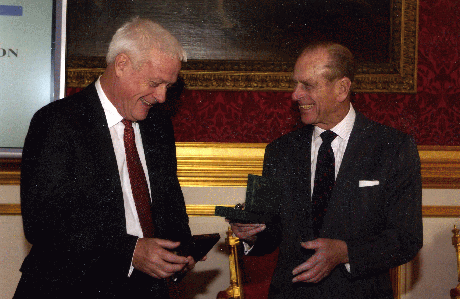 It
was announced last year that Professor Brian Morton OBE, an honorary
life member of the Malacological Society of London, was to be the
recipient of the 2004 Duke of Edinburgh Conservation Medal. Professor
Morton was presented with the medal by Prince Philip at a ceremony
held in St James's Palace on the 30th November 2004,
followed by a luncheon in his honour, also at St James's.
It
was announced last year that Professor Brian Morton OBE, an honorary
life member of the Malacological Society of London, was to be the
recipient of the 2004 Duke of Edinburgh Conservation Medal. Professor
Morton was presented with the medal by Prince Philip at a ceremony
held in St James's Palace on the 30th November 2004,
followed by a luncheon in his honour, also at St James's.
The medal was awarded in honour of Professor Morton's
vision and commitment to protect and promote the world's rich marine
biological diversity, particularly in Hong Kong and southern China.
Professor Morton retired from the University of Hong Kong in 2003,
but continues his research into marine science, conservation and
the Mollusca, dividing his time between his home in Littlehampton,
West Sussex, UK and Australia.
Elizabeth Platts
 Return
to top
Return
to top
Alan
Bebbington retires as Society's Archivist
 Dr
Alan Bebbington, a past President of The Society and long-standing
member of council, is to retire as The Society's Archivist. His
gentle guidance and knowledge will be sorely missed. However, as
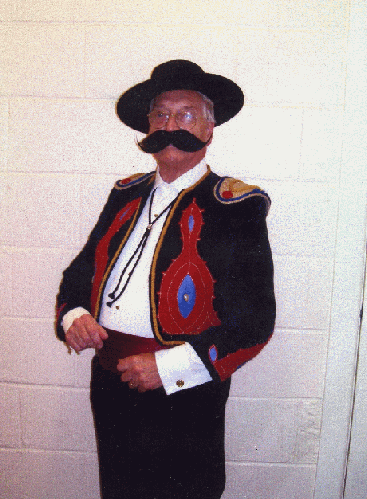
the recent photograph reveals, he continues to play an active role
in his local community.
Dr
Alan Bebbington, a past President of The Society and long-standing
member of council, is to retire as The Society's Archivist. His
gentle guidance and knowledge will be sorely missed. However, as
the recent photograph reveals, he continues to play an active role
in his local community.
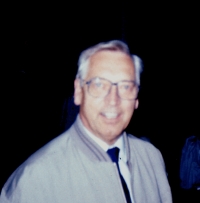
Alan in theatrical
costume, and (below) in 1993 at the
Society's Centenary
Celebration excursion to Down House.
Return
to top
The New Website
After many years of The Society's main web pages
being hosted at the University of Sunderland and the Bulletin at
the University of Ulster, The Society has consolidated these at
a new website at
http://www.Malacsoc.org.uk
This move has been accompanied by a re-design of
the pages to allow easier navigation and readability. Visitors to
the original Sunderland website have been automatically transferred
to the new site since December 2004. In its first month of operation
there were over 2,500 hits mostly by search engines and mostly from
the UK although there were visitors from 18 different countries.
Many thanks are due to Gina Smith, who was employed
as a placement student at the University of Ulster and completed
this work as part of her degree in computing. She has provided The Society with a flexible interface and a resource of images to be
used when compiling pages. She also transferred all the existing
electronic versions of the Malacological Society Bulletin (since
February 1997) to the new site in the new format.
The site will be continuously updated and any suggestions
for changes or additions should be sent initially to A.C...@ulster.ac.uk.
For future reference please note that the following
e-mail addresses will be forwarded to the appropriate officer of
The Society.
Pres...@malacsoc.org.uk
Webm...@malacsoc.org.uk
Secr...@malacsoc.org.uk
Memb...@malacsoc.org.uk
Tony Cook
Return
to top
New
Organizer for Forum
After organising seven Molluscan Forums, Alex Ball
of the Natural History Museum is handing over to Manuel Malaquias,
also at the NHM, for the next Forum.
Return
to top
New
Society Awards for Schools
To increase the public understanding of science,
the Council of the Malacological Society of London proposes to award
six prizes of £100 each to schools which can show that they have
taken, or propose to take, a practical, scientific interest in the
study of molluscs. Ideally, the awards will go to schools which
have developed a project or practical based on some aspect of the
biology of molluscs. Criteria for the awards could include scientific
quality, innovation, an interesting presentation, applied significance
and practical value in an educational setting. The aim of these
awards would be to try to increase the level of interest in molluscs
throughout the country. It is proposed to launch the Awards at the
Annual Meeting of the Association for Science Education in January
2006. For further information or comments, please contact the Secretary
of The Society.
Georges Dussart
Return
to top
The
Living World of Molluscs
This is a useful website for undergraduates and
amateurs edited by Robert Nordsieck.
Source: www.members.lycos.co.uk/Mollusks/schnecken.html
Return
to top
Giant
squid deaths off Spain
Five giant squid carcasses in 10 days in 2001 and
4 in one week in 2003 were found along Spanish coasts, compared
to only one a year normally. The deaths have been linked to offshore
seismic surveys nearby. Cephalopods respond to infrasound, probably
via the statocysts, and Angel Guerra in Vigo considers that damage
to the statocysts may have disoriented the squid which surfaced
and were then suffocated because their blood carries oxygen less
efficiently in warmer surface waters.
Source: New Scientist 2 October 2004.
Return
to top
Slug
courtship videos on web
Short videos of courtship of two Deroceras species
are accessible from Heike Reise's abstract in Bulletin 43 on The Society's website.
Return
to top
Cuttlefish
win matings by sexual mimicry
The giant Australian cuttlefish Sepia apama
forms large aggregations to mate. Small extra-pair males overcome
mate guarding by stealth or by mimicking the appearance and behaviour
of females, to gain a third of matings
Source:Hanlon
RH, Naud N-J, Shaw PW & Havenhand JN. (2004) Nature 433, 212.
Return
to top
Neotenous
origins of pelagic octopuses
'Ctenoglossans' are three tropical/temperate families
of transparent pelagic octopuses. They brood their eggs in their
arms. Molecular and morphological evidence shows they arose by neoteny
from the planktonic early-dispersal stages of familiar benthic octopuses.
The closest sister taxa are Antarctic and deep water members of
the Octopodidae. The divergence is estimated to have occurred in
the mid-Eocene, prior to the establishment of the Circum-Antarctic
Current. Retained larval characters include transparent body, reduced
internal organs, simple large chromatophores, Kölliker bristles,
and beak with teeth on the rostrum.
Source: Strugnell J, Norman M, Drummond AJ, &
Cooper A. 2004. Current Biology, 14, R300-1.
Return
to top
Shell coiling and embryonic cytoskeleton
The direction of shell coiling can be linked to
the spiral cleavage of the embryo, but recent work shows that spiral
cleavage is generated (and reversed) by more than one mechanism.
Reversal of cleavage has been attributed to reversal of cleavage
plane or to spiral rotation of micromeres during cytokinesis. Shibazaki
et al. show that dextral Lymnaea and sinistral Physa
show reversal of rotation of spindles, but sinistral Lymnaea
embryos initially show radial cleavage prior to cytokinesis. Spirality
in dextral embryos was replaced by radial cleavage by disrupting
the actin cytoskeleton.
Source: Shibazaki Y, Shimuzu M, Kuroda R. 2004. Current Biology,
14, 1462-1467.
Return
to top
Less competition in marine snails after
mass extinction
Shell drilling by muricid snails on bivalve prey
was more intense before a Plio-Pleistocene mass extinction in the
western Atlantic than afterwards. Muricids continued to drill through
the shell wall of their prey in Pleistocene and Recent snails, but
no longer drilled the edges. Living muricids attacked shell edges
under intense competition, suggesting Pliocene predators competed
more intensely than their post-extinction counterparts.
Source: Dietl GP, Herbert GS & Vermeij GJ (2004) Science
306, 2229-31.
Return
to top
Long-lived
fossil Antarctic clam
The fossil clam Cucullaea raea regularly
lived for more than a century in relatively warm (~14°C) shallow
Eocene Antarctic seas. Their cessation of growth in summer was probably
an adaptation to low chances of reproductive success in any one
spawning cycle. Food limitation, rather than low temperatures, may
have slowed growth and senescence.
Source: Buick DP & Ivany LC 2004. Geology 32, 921-4
Return
to top
Increased
CO2 levels impair calcification
Oceanic uptake of CO2 released to the
atmosphere from human activities is changing seawater chemistry.
The changes make calcium carbonate shells dissolve at shallower
depths and may ultimately impair calcification of pteropods, corals
and other marine organisms.
Source: Science 305, 5682, 362.(16 July 2004).
Return
to top
Marine
reserves on the High Seas
The 2002 World Summit on Sustainable Development
in Johannesburg agreed to establish a network of marine reserves
by 2012. Candidate reserves might include Rockall Bank (Scotland),
Grand Banks (Newfoundland), Rainbow Vent Field (Azores), Legatchev
Vent Field (mid-Atlantic ridge), Lord Howe Seamount Chain (Australia),
Tasman Seamounts, and Kerguelen and Heard Islands. However, the
UN General Assembly failed to introduce a moratorium on bottom trawling
in the high seas, which has a devastating impact on deep sea coral
ecosystems.
Source: Nicholls H. (2004) Nature, 432, 12-14.
Return
to top
Skin
cream from snail extract
Malacologists interested in possible anti-microbial
properties of snail mucus may be interested in a web site for a
skin care product, elicina cream, developed in Chile. The Bascunan
family originally bred Helix aspersa for export to France
and noticed how quickly minor cuts of the snail handlers healed
without infection or scarring.
Source: www.cremaelicina.com
Return
to top
Mercury handling by hydrothermal vent mussel
Bathymodiolus azoricus may have evolved
detoxification mechanisms as a result of natural exposure to mercury.
When exposed to mercury, its shell gaping increases, unlike other
bivalves which clam up. The resulting up to 10,000-fold elevation
of mercury in tissues was greatest in pseudofaeces, and suggests
the main Hg-handing strategy is elimination via mucus.
Source: Kadar, E et al. (2005) J. exp. Biol. 208,
505-513.
Return
to top
Global decline of Non-marine Molluscs
Land and freshwater molluscs are among the most
diverse and imperiled groups. This article, downloadable through
the AMS website, includes case studies of Pacific Island land snails,
Unionid mussels, and Spring snails of Australia and western N America.
Source: Lydeard C et al. (2004) Bioscience 54(4)
321-330.
Return
to top


 ..Click
An Image To Visit Society Website
..Click
An Image To Visit Society Website

